Parachromis motaguensis is a species of cichlid fish commonly known as the Guapote, Red Tiger Motaguense, or Motagua cichlid. Native to Central America (primarily the Motagua River basin in Guatemala and parts of Honduras), it is a large, predatory freshwater fish valued by aquarists for its striking appearance and by fisheries for sport and food in some regions.
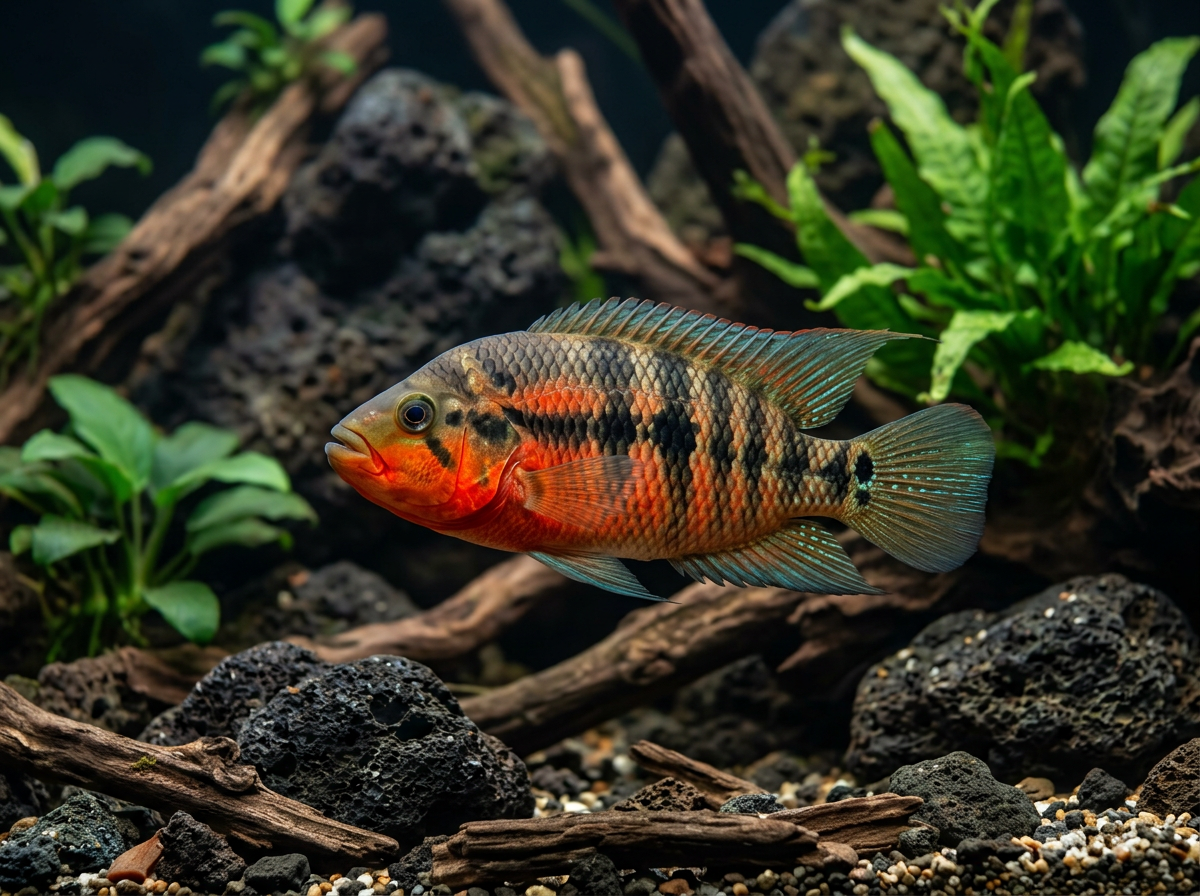
Parachromis motaguensis (The photo was created using AI)
Key characteristics:
Size: Adults typically reach 20–35 cm (8–14 in) standard length; some individuals can grow larger in optimal conditions.
Body and coloration: Elongated, laterally compressed body with a silvery to olive base color. Distinctive dark vertical bands or blotches along the sides and often a bright, iridescent blue or turquoise sheen on scales and fins. Unlike many other cichlids, mature females exhibit a much more intense and fiery red-orange coloration—particularly around the gill plates and flanks—whereas males grow larger but possess a more muted, greenish-silver hue.
Behavior: Aggressive and territorial, especially during breeding. Predatory diet consisting mainly of smaller fish, crustaceans, and invertebrates.
Habitat: Prefers slow- to moderate-flowing rivers, lakes, and reservoirs with rocky or structured substrates and plenty of hiding places.
Reproduction: Substrate spawner and biparental guardian; pairs defend eggs and fry aggressively.
Aquarium care: Requires ample space (large tank), strong filtration, stable water quality, and a carnivorous diet (high-protein pellets, frozen or live foods). Not suitable for community tanks with small or timid species due to aggression and predation.
Conservation status: Classified as Least Concern (LC) on the IUCN Red List. Local populations may still face localized habitat degradation, pollution, and overfishing pressures.
Note: Parachromis motaguensis is sometimes confused with related species such as Parachromis managuensis
and Parachromis dovii; accurate identification may require attention to patterning, scale coloration, and geographic origin.